DIY vs Professional Book Printing UK: Which Is Best?

Share

DIY or Professional Book Printing in the UK: Which Suits Your Project?
Quantity, finish, budget, and the author’s time narrow the printing options for a book project. Those options run from a home printer to a professional press, with print-on-demand between them.
What DIY printing actually involves
DIY printing means a consumer inkjet or laser printer, a trimming tool, and a hand-applied binding. The equipment is cheap, and the materials sit in any office supply store.
The binding is usually a staple through the fold or glue along the spine. Some authors learn Japanese stab binding or other hand methods. The results can be handsome objects in their own right.
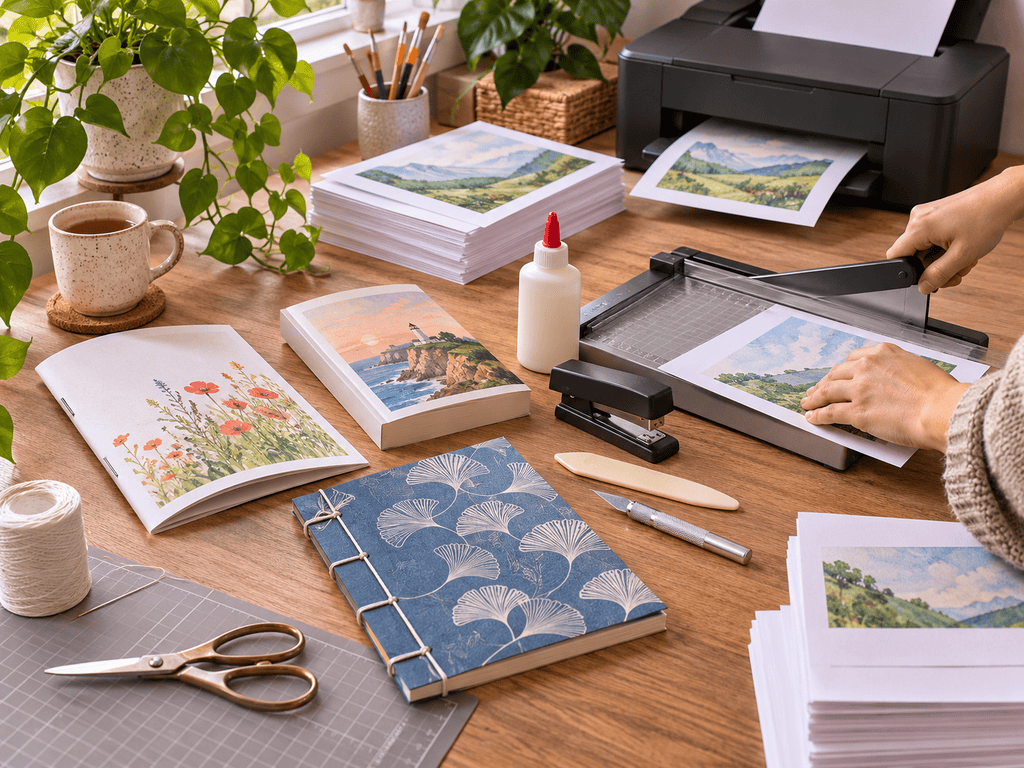
That handwork has genuine value for personal creative projects. Artist books and family histories made for relatives often gain from being visibly handmade. A stitched and lettered copy made for one person carries a value a press run can’t.
The route also suits working documents. Draft manuscripts and proof copies for early readers don’t need durable bindings or consistent covers.
The process stays fully in the author’s control. Pages can change between copies, and a single book can be remade until it is right.
Upfront spending is small. Ink cartridges and paper add up as the copies are made.
The larger cost is time.
Printing and binding a batch by hand takes an evening. Every additional copy repeats the same labour at the same speed.
Where home production holds up and where it strains
A home setup can produce one good copy more easily than a batch of identical ones. Hand trimming leaves edges that vary slightly between copies, and hand gluing leaves spines that vary just as much.
Colour can drift across a long home print session, and the cover on the first copy may come out visibly different from the last.
Home printers also feed only limited weights of card, which can make the covers thinner than a bookstore paperback’s.
Ink adds cost too. A consumer cartridge prints a limited number of colour pages, and a run of illustrated covers empties one quickly.
Paper can cause trouble as well. Sheets heavier than the intended stock may jam the feed, and spoiled pages add to the cost of every batch.
A long document can tie up the home printer for hours, and larger jobs push consumer machines past what they were built to do.
Home printing still fits some projects. The limits set a ceiling on consistency, and consistency is what buyers and stockists expect.
A book read once and kept on a family shelf can tolerate that variation. If it will be sold and re-read, the binding needs to withstand repeated opening.
Print-on-demand, the middle route
Print-on-demand services print a copy when someone orders one and ship it directly to the buyer. The author uploads the files once and never holds stock.
Most services connect directly to online retailers. When a reader buys the book, the order goes to the printer, and the author receives a margin on the sale.
This model fits steady online sales of a self-published title because there is no batch to store and no print bill to pay before anything has sold.
The author does not handle production. That removes the labour entirely, along with most of the control.

The trade-off appears in the per-copy price and the format menu. Trim sizes and bindings come from a fixed list.
The format menu covers common cases well, although unusual trim sizes and special finishes sit outside it.
Author copies follow the same path as customer orders. An author needing a box of books for a launch orders them like any customer does, with the same per-copy price and wait.
Delivery timing varies with each order’s place in the queue. That may not matter for a single online sale, but it can matter for a date-fixed event.
What a professional UK book printing company adds
Short-run digital printing has changed the economics of professional production. A UK book printing company can now produce small batches at prices that work for self-published authors.
Offset printing, the traditional method, becomes economical only at large volumes. Digital presses removed the need for large volumes. Professional book printing is now practical for authors who need modest quantities.
The difference begins with the equipment. Machines that bind large runs can also handle short ones, so a small batch gets the same construction.

A press run also gives consistent results. The first and last copies of a batch match in colour and trim.
Short runs suit first-time authors testing demand. A modest batch covers a launch and early sales, and a reorder follows if the book keeps selling.
File retention varies between printers, so it is worth agreeing this in advance. Confirming repeat-run specifications at the same time can simplify a later order.
Digital presses also tolerate small changes between runs. A corrected typo or an updated cover goes into the next batch using revised files.
A proof copy usually comes before the run. The author checks the colour and trim, and corrections happen before the full batch is printed.
Turnaround is agreed before ordering. The books arrive finished and boxed, ready to sell or hand out.
The author’s role becomes supplying files and approving the proof, while the printer handles the production hours.
Binding and finishing decide the quality gap
Perfect binding glues the page block into a wraparound cover and trims the edges square. It’s the standard construction for paperback fiction and most nonfiction.
Sewn binding stitches the folded sections together before the cover is attached. The construction handles years of repeated opening without a page coming loose.
Hardback case binding adds rigid boards covered in printed paper or cloth. It suits gift books and any title expected to last decades on a shelf.
Saddle stitching, a staple through the fold, serves thinner publications. Programmes and booklets of modest page counts use it well.
Dust jackets and ribbon markers are further options on the same scale, and each is routine bindery work.
Binding affects durability. A hand-glued spine suits gentle use, while a professionally bound spine is built for a book’s working life.
Finishing can separate a printed book from a printed manuscript. Buyers register the difference as soon as they pick up a copy.
A home desk does not hold this equipment. Print-on-demand services offer some of these bindings, though rarely the full range.
Paper and cover choices carry commercial weight
Paper weight controls opacity. Heavier stock shows less print through from the reverse of the page, and the book feels more substantial in the hand.
Show-through affects reading comfort. Text on thin stock carries the ghost of the reverse page, and dense pages become tiring to read.
Colour matters as much as weight. Cream stock is the convention for fiction, and white stock suits illustrated and reference books.
Cover lamination, in matte or gloss, protects the cover from scuffing and moisture. It also stiffens the cover, which changes how the book opens and holds.
A matte finish reads as understated and suits literary titles. Gloss sharpens colour covers and suits illustrated work.
Genre conventions shape these choices. A literary novel and a picture book need different stock and different binding.
Spine text needs precise placement to sit centred when the book is shelved. Professional finishing equipment positions it consistently across every copy in the run.
These details read as quality to a buyer browsing a table or a shelf. They are also details that a home setup cannot reproduce across a batch.
Matching the route to the project
The decision gets easier once the project is described in numbers and dates. Knowing how many copies are needed, and by what date, narrows the field quickly.
Quantity is the first filter. A copy or two for family belongs at home or on a print-on-demand service, as does a proof copy for checking.
A batch for a launch or a season of events belongs with a short-run printer. The per-copy price falls as the batch grows, and every copy arrives identical.
Time matters separately. Home printing converts evenings into production labour, while a professional run returns finished books by an agreed date.

Budget cuts across both. DIY can look cheapest until ink and spoiled copies are counted.
Proof copies for editors and early reviewers are a separate case. A small professional batch gives them a book that reads like the finished one.
Local bookstores and libraries that stock a title expect a saleable product. Consistent trimming and a durable spine are what make a copy saleable.
Premium editions follow the same logic. A signed hardback version for early supporters can justify a short professional run on its own.
Many self-published authors end up using two routes at once. Print-on-demand covers ongoing online orders, and a short run covers launches, events, signings, and direct sales.
The same files usually serve both. A cover prepared for one route can generally be adapted for the other.
How to choose a UK book printing company
Start with binding methods. A company offering perfect, sewn, hardback, and saddle-stitched work can match the construction to the project.
Ask about paper and request a proof. A physical proof shows the colour and the spine placement before the run is paid for.
Check the minimum order and the stated turnaround. Both should be clear before any files are sent.
Pricing should be transparent. Credible companies publish prices or return quotes quickly, and the quote states what is included.
Pay attention to how questions are handled before ordering. Clear answers about files and costs at the inquiry stage usually predict a smooth run.
Environmental credentials are worth checking. Some UK printers offer carbon-balanced production, where the emissions from printing are measured and offset.
Samples tell more than a website can. A company confident in its work will send examples of previous books on request.
Reprints belong in the decision too. A company that keeps files on record makes the second run simpler than the first.
Location within the UK keeps delivery simple. It also makes any problem with the finished run easier to resolve.
The right route matches the quantity, finish, budget, and time the project allows. For a single keepsake, an evening at the home printer may be enough. If the book will be sold, shelved, lent, and read more than once, a professional run is usually the better fit.