How to Schedule SysML Training Before Your Team’s First Model Review

Share

Preparing for a First Model Review: A Practical Guide to Scheduling SysML Training
Most project leads schedule SysML instruction as an early checkbox and pay for it at the review. Engineers finish a course, return to document work for weeks, and freeze when a reviewer asks them to walk a live diagram. A schedule built backward from the review date avoids that gap.
Work backward from the review date
Systems engineering practitioners who run model-based programmes typically start instruction early enough to cover foundational lessons, applied practice on project material, and a rehearsal before the first formal review. The time required varies with the team’s starting skills, the scope of the review, and the hours available for practice. Training completed too far ahead tends to decay before the team ever opens the model for an external audience.
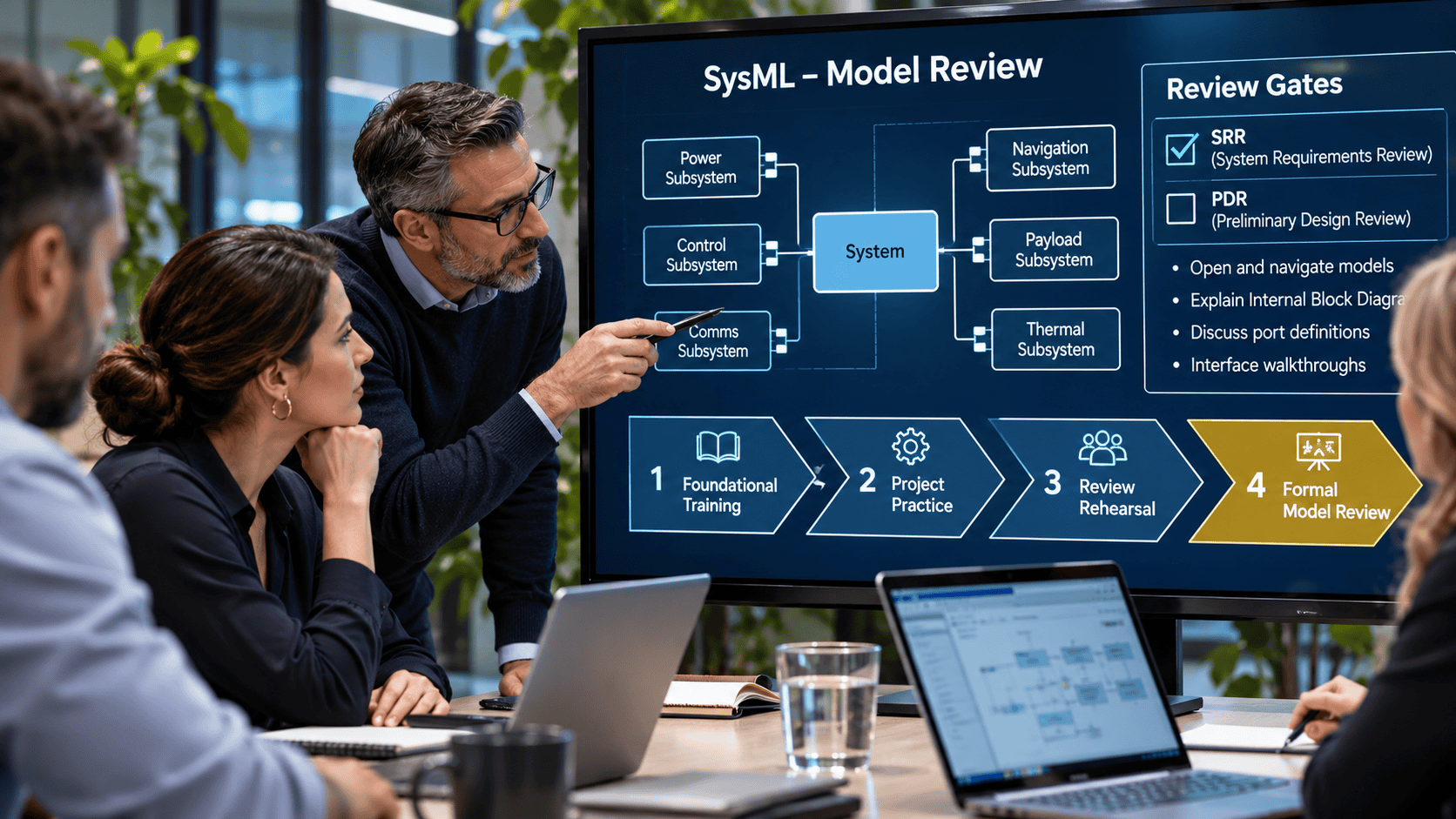
Formal gates such as the SRR and the Preliminary Design Review set their own expectations, which depend on the programme and the agenda agreed with reviewers. Some reviews ask authors to open Internal Block Diagrams and explain port definitions on the spot, while others accept prepared material. Where live navigation and interface walkthroughs are part of the planned review, the schedule should treat that performance as the deliverable the whole effort supports.
Separate language syntax from project methodology
A SysML course teaches the language: blocks, ports, flows, and common diagram types. It does not teach how a given programme names its elements or traces its requirements. Those conventions live in the project’s model governance documents and style guides, and they differ from one programme to the next.
An engineer can draw a syntactically correct Activity Diagram that still violates the project’s rules for allocation or abstraction level, so the schedule needs dedicated style-guide sessions after the syntax portion ends. Those sessions should walk through the style guide element by element, using examples pulled from the project. Conventions on allocation, naming, and abstraction level build on the language rules and give learners concrete cases to apply.

The OMG-Certified Systems Modeling Language (SysML) Professional credential, known as OCSMP, validates baseline language proficiency. The Object Management Group maintains the SysML specification, and its certification page describes coverage of model interpretation plus, at builder levels, model construction, analysis, and organisational modelling skills. That scope is still not the same as rehearsing the review tasks a specific project will demand. Leads can treat credential preparation as one track and project-specific practice as another.
Split the curriculum by role
Not everyone who attends the review needs to author diagrams, and the curriculum should reflect that. Programme managers, quality staff, and customer representatives need reader skills: opening a model and following a trace. Authors need the deeper track: Block Definition Diagrams, Internal Block Diagrams, and behavioural diagrams in working detail.
A tiered structure keeps each group in the instruction that matches its actual review duties. Programmes often arrange structured sysml training to move teams from basic diagramming literacy to defensible, review-ready architecture. INCOSE maintains a systems engineering competency framework that distinguishes proficiency expectations across roles, giving programmes a basis for the split.
Both tiers need a scheduled block on requirement traceability. Reviewers routinely ask how a stakeholder requirement maps to a design element, and the answer lives in the model’s trace links. Readers must follow those links, and authors must build them correctly before the review.
Train on project artefacts, not sandbox examples
Generic vendor exercises use clean, small models that behave predictably, and project models do not.
The final phase of instruction should move the team onto real or sanitised project artefacts drawn from its own repository. Where the real model carries proprietary content, a sanitised copy preserves the structure without exposing sensitive detail. The team should become familiar with the actual package layout and diagram density the reviewers will see.
Tool choice drives much of this phase: Cameo and Enterprise Architect handle validation rules and diagram layout differently. Fluency in one environment transfers imperfectly to the other. Practice sessions should run inside the same tool configuration the team will use at the review.
Verification and validation procedures belong in this phase as well, executed against the actual model. Running those V&V checks internally lets the team read the results before an external reviewer does and find broken constraints and orphaned requirements while there is still time to fix them.
Run a dry run before the formal gate
An internal dry-run review, held early enough to address gaps before the milestone, tests the team under realistic conditions. Authors must navigate the model live and explain architecture decisions under unscripted questioning. Gaps found in the dry run can still be corrected, while gaps found at the formal gate may delay approval.

The dry run should mirror the real agenda, with the same traceability spot checks and behavioural walkthroughs. Observers who were not involved in the modelling make the best stand-in reviewers, because they ask the questions the authors stopped seeing. One well-run rehearsal often changes what the team chooses to practise in the final week.
The resulting schedule runs syntax first, conventions second, project artefacts third, and the dry run last. Each phase helps the next one hold until the review. When training is tied to the gate as a risk-reduction milestone, the team arrives ready to be examined.