
7 Ways to Get a Luxury Kitchen on a Flat-Pack Budget

Share
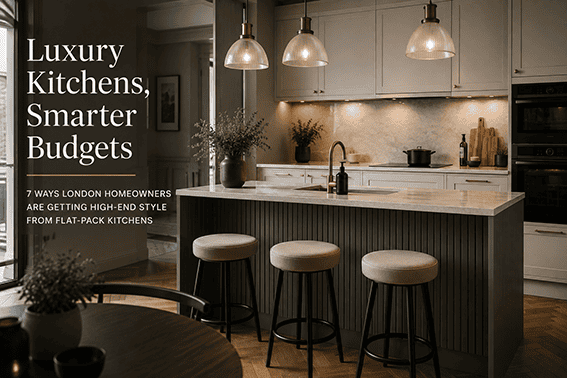
How London’s Stylish Homeowners Are Making Flat-Pack Kitchens Look Expensive
There is a quiet shift happening in London’s most design-conscious postcodes. Homeowners who would never compromise on a hotel or a holiday are increasingly happy to buy their kitchen carcasses from IKEA or DIY Kitchens rather than a bespoke joinery house. What they refuse to compromise on is how it all comes together. The brand on the cabinet door, it turns out, matters far less than who fits it, and a growing number of London properties now carry a flat-pack kitchen that nobody would ever guess started life in a flat box. Here is what the smart set has worked out about getting a genuinely luxurious kitchen without a bespoke price tag.
1. They understand that installation defines the look, not the brand

Two identical flat-pack kitchens, fitted by two different teams, can look worlds apart. Doors that sit flush, drawers that glide without a rattle, plinths and cornices that meet the wall properly — none of that comes from the manufacturer. It comes from whoever holds the spirit level and takes the time to get cabinet sequencing and tolerances right before a single screw goes in. Style-conscious buyers have stopped asking “which brand” and started asking “which fitter”, because that is the decision that actually shows up in the finished room.
2. They treat IKEA and DIY Kitchens as serious options, not compromises

IKEA’s METOD system and DIY Kitchens’ online-only ranges were both built to a genuinely high manufacturing standard — precise tolerances, solid carcasses, a wide choice of door fronts from painted shaker and handleless slab through to woodgrain and in-frame styles. What neither brand supplies is a local support network or an installer of your choosing; both are, by design, a self-assembly proposition. That is the part homeowners now budget for separately, treating it as the difference between a passable kitchen and a beautiful one, rather than an afterthought once the boxes have already arrived.
3. They skip the IKEA installation queue for a dedicated independent team

IKEA Home Services is subcontracted to a network of independent fitters, and lead times typically run four to eight weeks from purchase, with little say over who turns up or when any snagging gets resolved. If a door is misaligned or a panel arrives measured wrong, coordination usually has to go back through IKEA’s own customer service chain, which can add weeks to a project that was otherwise ready to go. Homeowners who want the work done to their own timetable are increasingly booking specialist IKEA kitchen fitters directly, arranging a start date within weeks of delivery and dealing with any snagging over WhatsApp rather than waiting on a call centre to schedule a return visit for a misaligned door.
4. They upgrade worktops and end panels even on a flat-pack budget

A flat-pack carcass with a templated stone or solid wood worktop, proper end panels and neat cutouts around the hob and sink reads as considerably more expensive than it is. This is one of the easiest upgrades to make without touching the cabinet budget at all, and it is usually the first thing a guest actually notices when they walk into the room, long before they clock which brand the units came from.
5. They choose flush-fit appliances over anything visibly “bolted on”

An integrated fridge-freezer that sits proud of its cabinet, or an oven with a visible gap around the housing, undoes a lot of otherwise good work. Getting ovens, hobs, extractors, dishwashers and fridge-freezers properly integrated — flush, level and fully operational within the run — is a finishing detail rather than a technical one, but it is the detail that separates a kitchen that looks fitted from one that looks assembled around whatever was in the delivery van.
6. They bring in specialist DIY Kitchens fitting for handleless and in-frame styles

DIY Kitchens has no showroom and no installation arm of its own, which keeps its prices competitive but leaves buyers to find a competent fitter themselves. This matters most on handleless and in-frame ranges, where gap consistency around every single door is what makes the style work at all, and where a general handyman is most likely to leave a run of cabinets looking slightly off rather than seamless. Homeowners going this route have learned to budget properly for DIY Kitchens fitting from a team that has handled the brand’s carcasses before, understands how the units need to be levelled before worktops are even measured, and can manage the delivery, plumbing and finishing under one quote rather than several.
7. They insist on certified plumbing and electrics from day one
Sink connections, hob and oven circuits, integrated lighting — none of it should be an afterthought once the cabinets are in. Homes fitted properly use Gas Safe registered engineers for gas connections and Part P certified electricians for anything on the circuit, coordinated as part of the same installation rather than booked in afterwards as a string of separate trades. It is the least glamorous item on this list, but it is the part that keeps a beautiful kitchen safe and functional for years rather than months, and the part most easily skipped by anyone cutting corners.
None of this requires a bespoke joinery budget. It requires treating installation as the investment it actually is, and choosing fitters who have handled the brand’s specific ranges before, not just kitchens in general. Most standard installations run three to five days once a proper survey has been done, which is a remarkably short window for a room that will carry the rest of the house’s style for the next decade. The result is a kitchen that reads as considered and expensive, built on a foundation that was never meant to be extravagant in the first place.

